How to Build a Social Network Website From Scratch: Full Guide for 2026
Updated 05 Dec 2025
19 Min
2667 Views
How to build a social media platform from scratch? This question is becoming quite relevant in the modern world, where social media has become a powerful one-stop shop for all of their daily needs. Communication, selling, advertising – everything goes online. In this regard, creating a social media website is the primary condition for businesses to survive in the current social media age.
Here are the 7 steps to build a social media website:
- Step 1. Define your concept. A clear target audience and USP guide the platform’s value.
- Step 2. Choose a development partner. The right team ensures efficiency and scalability.
- Step 3. Run a solution workshop. Align business needs with practical technical solutions early.
- Step 4. Complete the discovery phase. Streamlines development and reduces risks.
- Step 5. Prioritize UI/UX design. Intuitive and interfaces increase engagement and retention.
- Step 6. Development. Developers implement features while QAs ensure reliable performance.
- Step 7. Launch and promote. Deploy the platform live and use SEO, social media campaigns.
Cleveroad is a software development vendor with 15+ years of delivering tech solutions. We’ve prepared a practical guide that will walk you through social media website development, covering popular social network types, website creation approaches, and key steps to bring your idea to life. So, why don’t you keep on reading?
What Is a Social Media Website and Why Do You Need It?
A social media website refers to a community where groups of people can interact via chats or online calls, create and share textual or video content, purchase products/services, comment on other users’ posts, make their own network of contacts, and much more. It’s also a great marketing tool, allowing for client segmentation and targeting for creating powerful marketing strategies and brand planning.
Social media influence: market overview
We wouldn't be talking about how to build a social media website if social media weren't successful and promising, right? So we’ve decided to collect some optimistic predictions and statistics to strengthen your decision to enter social media with your own website:
- Datareportal states that more than half of the world (62,6%) now actively uses social media, with an average of 2h 20m spent daily
- Statista predicts that the number of social media users will increase to over six billion in 2028
- A study by the European Journal of Information Systems showed that information provided on social network websites has already received more influence on public perception than traditional media, and is commonly used for advertising
- According to Forbes Advisor, the average individual globally boasts 8 social media accounts, ranging from an average of 3 in Japan and 12 in India
Statistics prove that the social media market is constantly evolving, and its growth will be even more significant in the coming years. This is why creating a social media website is an excellent strategy for startups and functioning businesses.
Types of social media websites
Planning to build your own social media website, it’s vital to define what type of networking service you want to create. It’s not limited to social platforms like Facebook or Instagram. Commonly, every website refers to one of the popular social media groups depending on the concept and features provided. Let’s consider the most popular types of social networking platforms.
Social platforms
Social platforms are websites focused on communication, photos, and experiences with friends or public audiences. They emphasize user-generated content, social interaction, and community building.
Entertainment platforms
Entertainment platforms are designed to deliver fun, engaging, or niche content such as hobbies, fan communities, or events. To build a social media website for entertaining, you’ll need to prioritize discovery and storytelling.
Educational platforms
eLearning social media websites are aimed at learning, research, and academic collaboration. When you create an education website, you enable users develop skills, or share scholarly work.
Professional platforms
Websites built for career development, networking, and recruitment. They host resumes, job listings, industry news, and professional communities. Users build credibility through profiles or shared expertise.
Dating platforms
Dating website development is meant to connect people seeking relationships, friendships, or matches based on preferences. They use profiles, matching algorithms, or location-based discovery.
Corporate platforms
Internal communication and collaboration networks are used within organizations. They streamline workflows, messaging, file sharing, and team coordination.
Features of Social Media App
To understand how to make a social media website, you should consider what features to include. The functionality may vary in different applications, but it is better to start building a Minimum Viable Product (MVP) version, including only basic features.
MVP development services allow you to create your own social media site with minimal required functionality, validate your idea, increase the number of active users, and collect initial feedback before investing more. Moreover, the MVP version increases the chances of getting investments since a working social website makes stakeholders trust you more.
So, the basic features to build your own social media website are:
Profile creation and editing
This feature is the first one you should think about when planning how to create a website for social media. Start with fast and convenient registration, including several options like email, phone number, or Google/Apple accounts. To allow users to make the most out of this feature, add multiple personal profile customization tools and diverse privacy settings.
Content publishing
It's a foundation for all social networking solutions. Building a social network site, implement tools for creating, editing, and publishing media content, as it is the primary function of such platforms. You can include several content types (e.g., text, pictures, videos, audio, etc.) and also add free and paid templates allowing users to deliver unique post designs.
Engage more user by empowering your social media website with generative AI for media creation. Cleveroad's AI engineers are ready to help you
Like, comment, and share options
These features are the basics required to build a social media site. Social media is the place where people can present themselves and show their awareness of multiple things, and they expect a reaction to their posts. Implement various interactions to allow active users of social media to build a community within your application. This function will help you attract opinion leaders to your platform, ready to pay for their brand promotion.
Want to engage more users with a mobile app? Read our guide explaining how to create a social media app
Newsfeed
A dynamic newsfeed keeps users updated with relevant content. How to create a social network website feed? There are several important points to consider. Implement an algorithm to sort new social network posts based on user preferences and interactions, and remember to prioritize news from friends. Moreover, newsfeeds are crucial for monetizing your social media, so you should include ads and sponsored content to generate a steady income.
Secure messaging
Messaging is the cornerstone of social media websites. Basic communication includes one-to-one and group chats with multimedia support. However, this feature causes a demand for more protection since social networks store users' personal information. Thus, secure message exchange between participants is critical when building a social network website. For this purpose, you have to integrate TLS/SSL protocols to ensure that all conversations will be confidential.
Notifications
When you make a social network, remember to keep users informed about the latest updates in their profiles. Add real-time notifications on your platform about new messages, friendship requests, likes, and comments. You can also send reminders by email if users are offline to allow them to check the news at their convenience.
Admin panel
The admin panel is a must-have for all social networks, allowing owners to manage platform content and users. Here are the main tools it should include:
- User management (ban, restrict, or approve accounts)
- Content moderation tools (flagging, reviewing, and removing inappropriate content)
- Analytics and reports on user activity and engagement
- Settings for site-wide preferences and configurations
- Tools for managing advertisements and monetization options
How to Create a Social Media Website in 6 Steps?
Now, it's time to proceed to the central part of our article – how to build a social network website from scratch. As a software development company with expertise in social media website development, we’ll discuss the appropriate steps you need to take to design a cost-effective product that aligns with your requirements and market demands.
Step 1. Define the idea and core concept
To make a social network website, start with a strong idea and concept. Start by defining your target audience. Go beyond basic demographics to understand your potential users' specific interests and needs. Next, evaluate the strengths and weaknesses of existing social networks. What features do they offer, and where are they lacking?
Finally, define what will make your platform unique. Consider the specific features that will set it apart from the competition and its main purpose. Ask yourself what value you can offer that you don't currently have. Based on this, define a Unique Selling Proposition (USP) that will make your own social website stand out.
What unique features or services will your platform offer? This could be anything from a novel content-sharing method to advanced privacy controls or integration with other services.
Step 2. Choose a reliable development partner
How to start a social media website? Choosing a reliable web development partner is a very important step in defining your product’s success. Regarding social networking website development, the most cost-effective approach is IT outsourcing, which provides access to a wide pool of talent worldwide. Moreover, you are free to choose one of the flexible cooperation models that best suits your needs:
- A Dedicated Development Team allows you to hire a full-fledged team to develop social networking websites. All processes will be managed by your vendor's manager, allowing you to free up your time for other business tasks and enhance productivity
- IT Staff Augmentation services allow you to fill in the missing expertise for your project. You can hire all the necessary specialists and get full control over the social networking website development
When choosing an outsourcing vendor, consider their experience and expertise in web development services. Also, study the portfolio of the potential IT partner and customer reviews on hiring platforms like Clutch, GoodFirms, or IT Firms.
At Cleveroad we delivered multiple social media software projects, and would like to share one of the most vibrant cases with you.
Ayoo Dance is a global social networking platform created by a dance enthusiast to unite dancers worldwide into a vibrant community. We’ve developed and delivered the platform in 2018 for our client from Switzerland.
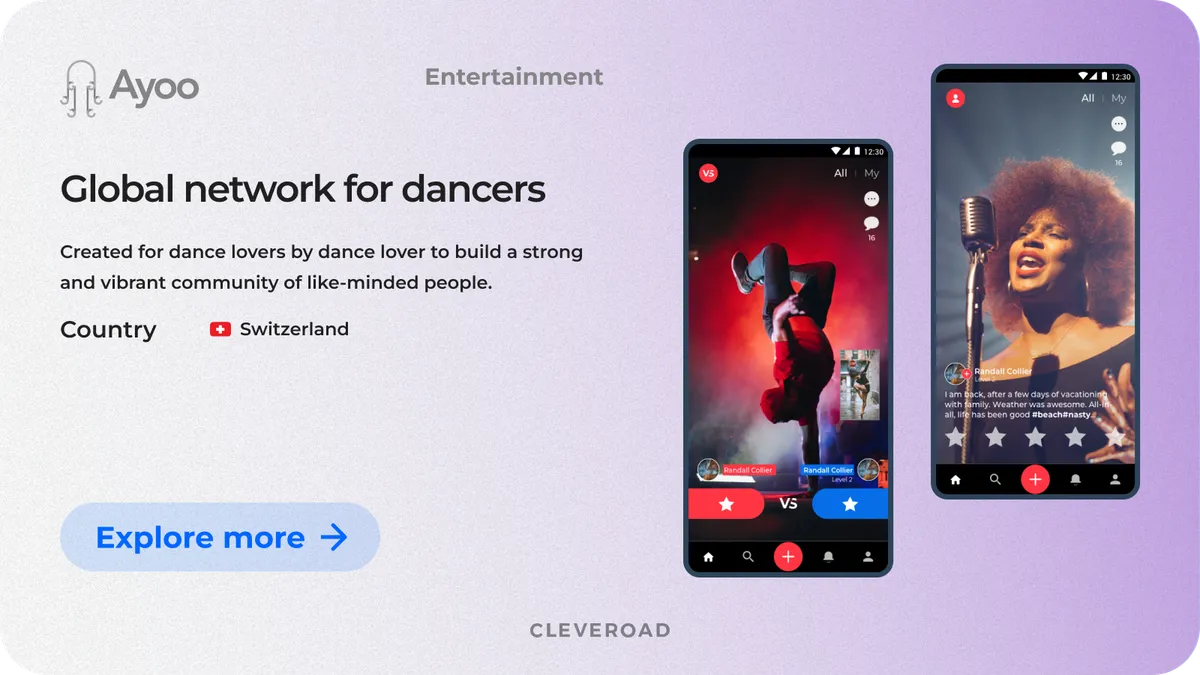
Ayoo Dance: a global social networking platform for dancers designed by Cleveroad
Our engineering team developed a mobile app capable of rapidly growing an active community, along with a web-based admin panel for efficient content and user management. The solution connects people passionate about dancing, allowing them to showcase skills, compete with friends online, watch performances, and engage with like-minded users. To ensure instant content delivery and a seamless user experience, we implemented advanced media processing workflows, configured high-performance servers, and sourced as well as imported the initial content needed to launch and grow the platform.
As a result, the client gained a fully scalable platform that quickly attracted an active global dance community and boosted user engagement through seamless media sharing. The admin panel reduced moderation time and improved control over content and user activity. The optimized infrastructure and ready-to-use initial content accelerated time to market, helping the client grow the platform faster with lower operational overhead.
Here’s what Nicolai Altwegg, CEO at Ayoo AG, says about collaboration with Cleveroad on creating social media platform:

 Switzerland


Step 3. Conduct a Solution Workshop
A Solution Workshop is the first collaborative stage where your business needs are aligned with a feasible technical plan. The team clarifies expectations, analyzes functional scope, and proposes suitable technologies to build a social website from scratch. At the end, you receive a structured proposal that describes the envisioned platform, constraints, and implementation approach, giving you a clear picture before deeper planning.
At Cleveroad, the Solution Workshop is provided completely free of charge, giving you an early, risk-free way to validate your idea.
Step 4. Go through the Discovery Phase
The Discovery Phase refines your idea into a validated development roadmap. Specialists document business processes, finalize feature sets, design system architecture, and prepare UX concepts, setting up the foundation of how to make your own social media site.
During the Discovery Phase, experts typically:
- Analyze business goals, user flows, and technical constraints
- Prepare detailed functional requirements and a feature list
- Develop preliminary architecture and integration planning
- Create a UX concept outlining core navigation and key interactions
You receive detailed requirements, risk assessment, development timelines, and a precise implementation plan that accelerates the production stage.
Step 5. Prioritize UI/UX design
Design is essential to create your own social media website, as the visual appeal and user experience play a major role in its popularity. A compelling and intuitive design attracts users and enhances engagement.
UI/UX design services include creating a detailed website prototype, page by page, based on the approved wireframes from the Discovery phase and the project’s requirements. They incorporate current design trends to ensure the platform is functional and visually appealing.
Once the prototype is completed, designers hand it off to developers and shift to a supportive role, assisting with any design-related issues during development to ensure the final version of social media site meets your expectations.
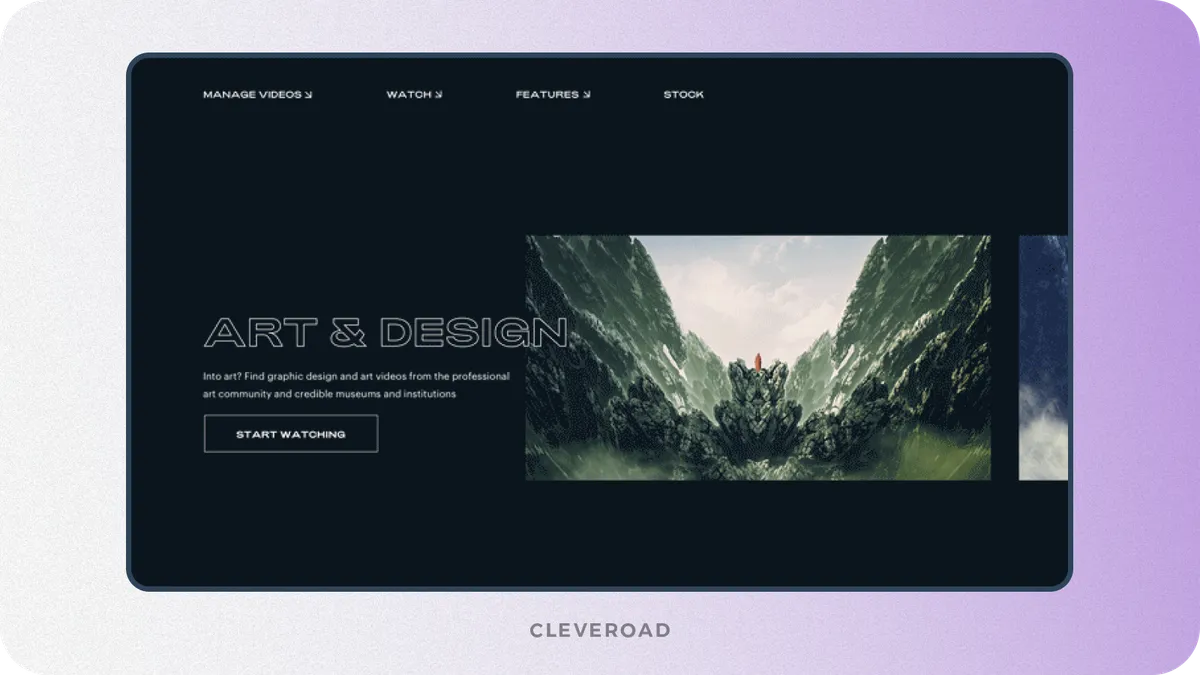
Social media website design by Cleveroad
Step 6. Develop social networking website
Developers work with UI/UX mockups and product specifications to turn it into a functioning social networking site during the development phase. Today, IT companies most often follow the Agile SDLC, working in two-week sprints. Developers create a social media website functionality during each sprint.
After each sprint, QA engineers conduct thorough testing of all implemented features. If bugs occur, they send reports to the software developers to fix them. After completing all sprints, they perform comprehensive regression and load testing to ensure the site functions properly and can handle heavy loads. Throughout the process, the project manager monitors the work, and technical experts make recommendations on feature feasibility and complexity.
Step 7. Launch and promote
After creating a social media website from scratch, software engineers perform final tests to ensure that the social media website is ready for release. This includes finalizing features, fixing outstanding issues, and ensuring all platform aspects meet the required standards. Once the polishing is complete, the developers push your social networking site to a live server to make it available to users and hand over all product materials to you.
However, building a social media site is not enough for its success. Once launched, it is important to focus on marketing to increase the platform's popularity and user engagement. Effective marketing strategies include social media advertising, search engine optimization (SEO) to improve search visibility, and content marketing to engage users. You can combine these and use additional methods that seem appropriate to promote your social media website and attract many users.
Tips to Build a Successful Social Media Site
Apart from the obvious steps, such as defining an idea and building a social network website code, you should also consider some other important aspects that can affect the success of your product.
Choose a development approach
When building a social media website, you can choose one of these approaches:
- Using website builders
- Opting for custom software development services
Using website builders
Website builders provide a quick setup with pre-designed templates and drag-and-drop functionality, requiring minimal technical skills. However, they have limited customization and functionality, and using common templates may make your platform less unique.
Opting for custom software development services
Custom social networking website development allows building a platform from the ground up, integrating tailored features, designs, and logic to meet your goals. While this approach takes more time and investment, at Cleveroad, we recommend it for long-term benefits, delivering a distinctive user experience and a competitive edge.
Below you’ll find a more detailed comparison of off-the-shelf and custom social media site development approaches:
| Aspect | Social media website builder | Custom social media site development |
|---|---|---|
Development time | 1-4 weeks | 3-6 months |
Cost | $500-$5,000 | $50,000-$150,000+ |
Customization | Limited templates | Fully custom features and design |
Scalability | Limited | Highly scalable |
Control | Restricted | Full control |
Maintenance | Managed by builder | Requires dedicated team |
Technical skill | Minimal | Professional expertise needed |
Best for: | Quick launch, MVPs, small communities | Unique platforms, complex features, long-term growth |
Pick suitable technologies
Choosing the right web development tech stack is crucial to creating a social media website, ensuring the smooth operation, reliable data storage, and overall success of your social media website.
Your web development partner will select tools and technologies depending on your individual requirements, including the scale of your social network site, expected user base, and unique functionality needs. However, we are ready to show you an example of the technology stack our team typically uses for social networking website development.
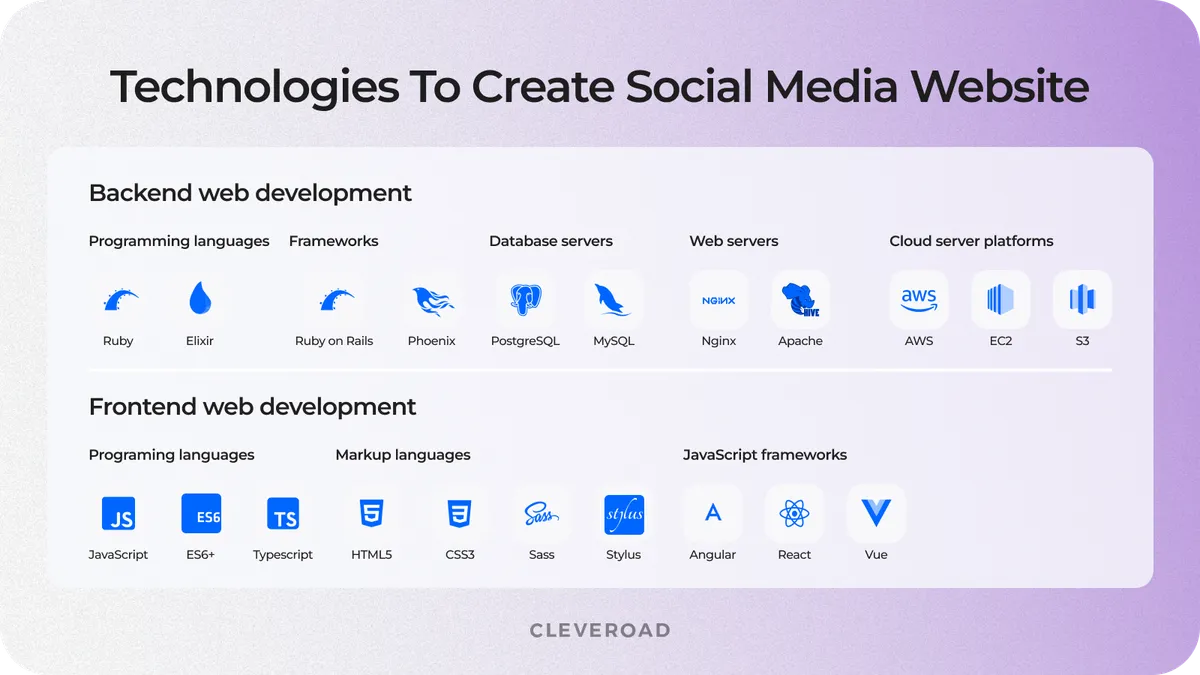
Social media website development tech stack
Develop a robust brand identity
A strong brand identity is critical to make a social media website successful. Based on Cleveroad’s experience with social network projects, a clear and appealing brand helps your platform stand out, build trust, and foster user loyalty. Simple recommendations include:
- Define your purpose: Be clear about what your platform represents and its core values.
- Create a memorable logo: Design a simple, recognizable logo that reflects your brand.
- Use consistent styling: Choose a palette and typography that convey your brand identity.
- Develop a unique voice: Maintain a consistent tone in all communications.
- Engage authentically: Interact with your audience genuinely and regularly.
- Leverage social media: Promote your platform and connect with users on multiple channels.
Wisely choose the monetization model
How to develop social networking website and turn it into a profitable asset? Consider several monetization strategies and choose the most appropriate for your business. Here are the most popular ones:
Advertisments
Ads are the most demanded way to get revenue for a social media website. Pay attention to design and overall concept. Ensure your platform has enough space for engaging banners to captivate Internet users’ attention.
Brand promotion
This approach implies that you promote content posted on your website by separate companies and get paid. Digital content suggested to the target users shows up at the top of the newsfeed to obtain more views.
Paid features
Many social networks offer premium subscriptions to provide some additional features. YouTube offers ads-free video viewing, LinkedIn allows customers to see who viewed their profile and submit access to multiple courses.
You can select any monetization strategy you assume is appropriate for your social media website or app. Moreover, you can even combine them all to increase revenue stream and make your own social website even more profitable.
Top 3 Trends for Social Media Site Development
Modern social media site development focuses on personalization and new ways to enhance engagement and usability. By following the trends we’ve listed below, it’ll be easier for you to understand how to create a social network that resonates with users and stands out.
1. AI-powered personalization
According to AI Agent Store, AI-driven recommendation engines now influence about 70% of what users see on major social platforms. This personalization boosts user engagement and retention by serving content aligned with individual interests and behaviors. Using AI for feed curation and user profiling, platforms can help you increase time spent and overall satisfaction, making them more “sticky” for returning users.
At Cleveroad we provide top-notch AI development services that you can utilize to provide high-level custom experience for every user
2. Machine learning for content moderation
ML algorithms are used within social media platforms to automatically detect spam, offensive content, and fake accounts, keeping communities safe and enjoyable. Wifitalents states that nearly 65% of all social media platforms have already adopted ML for moderation. Automated moderation saves resources and ensures a reliable, trustworthy environment. Incorporating ML is a key consideration when figuring out how to create a social network that scales efficiently while maintaining compliance and quality.
3. Generative AI for content creation
Generative AI tools are increasingly used to help users create posts, captions, and multimedia content, accelerating content production and diversity. According to SQ Magazine, AI content rises significant curiosity among users; 60% of users show interest in AI-generated music, 57% in comedy videos, but less so for ads (34%) and podcasts (35%).
This trend lowers barriers for users, enabling more frequent posting and fresh content, which drives user activity and platform growth.
We offer gen AI development services to help you seamlessly integrate GenAI functionality within the social media site to engage users with interactive content creation
How Much Does It Cost to Build a Social Media Website?
Considering the difference in the amount of work your specific social media website project require, the costs will approximately range from $100,000 to $120,000+ to build social networking website.
The final price to build a social media site will vary depending on factors such as features, design, 3rd-party integrations, etc. That’s why it is hard to estimate the exact cost without knowing exact product requirements. However, our analysts have calculated the approximate cost to create social network website based on the basic features. Our estimation is based on a $50/h rate typical for Central and Eastern Europe.
| Social media site module | Development time (h) | Estimated cost ($) |
|---|---|---|
Register | 27 hours | $1,350 |
Login | 20 hours | $1,000 |
Complete profile | 13 hours | $650 |
Profile | 37 hours | $1,850 |
My favourites | 18 hours | $900 |
Purchase history | 19 hours | $950 |
Group | 25 hours | $1,250 |
Playing videos | 30 hours | $1,500 |
Settings | 21 hours | $1,050 |
Live lessons | 19 hours | $950 |
Content | 34 hours | $1,700 |
Adviser’s profile | 36 hours | $1,800 |
Group management | 19 hours | $950 |
Push notifications | 13 hours | $650 |
Admin panel | 169 hours | $8,450 |
Total development time and cost | 500 hours | $25,000 |
However, this estimate includes development time only. The costs for UI/UX design, project management, Quality Assurance, etc., are not included and should be estimated separately. Also, do not forget that you will have to pay monthly for hosting the website and updating it from time to time to stay on the cutting edge of technology. If you want to receive a rough estimate of costs to develop social media network, feel free to book a meeting with our managers.
Cleveroad’s Experience in Building Social Media Websites
Cleveroad is a professional software development company with 15+ years of experience in Social Media development. We help companies and various-scale businesses meet their objectives, improve user engagement, and expand the sales funnel with contemporary web solutions.
We offer a variety of advantages to start their own social media website:
- Expertise in implementing social media tools and integrations to optimize development time and budget: Google Maps, Apple/Google Pay, Blockchain, NFC, GPS, Twillio, and others
- On-demand IT services aligning with your tech needs: software engineering, cloud development and migration, UI/UX design, Discovery Phase, DevOps services, Quality Assurance, monitoring & maintenance, etc.
- Free Solution Design Workshop aimed to align your social media platform vision with technical implementation
- Mature quality management and robust security management assured by ISO 9001 certificate and ISO 27001-certificate proving our commitment to providing the best service
- Flexible cooperation models to suit you social media project need: Dedicated Development Team services and IT Staff Augmentation
To demonstrate our experience in social media software development, we would like to present one of our client social media software case from our portfolio.
A US-based enterpreneur partnered with Cleveroad to develop an iOS Donation-Based Social Network With Streaming. The customer wanted a platform that combined community interaction with a business model supporting donations and subscriptions, and tasked us with handling the full product development lifecycle.
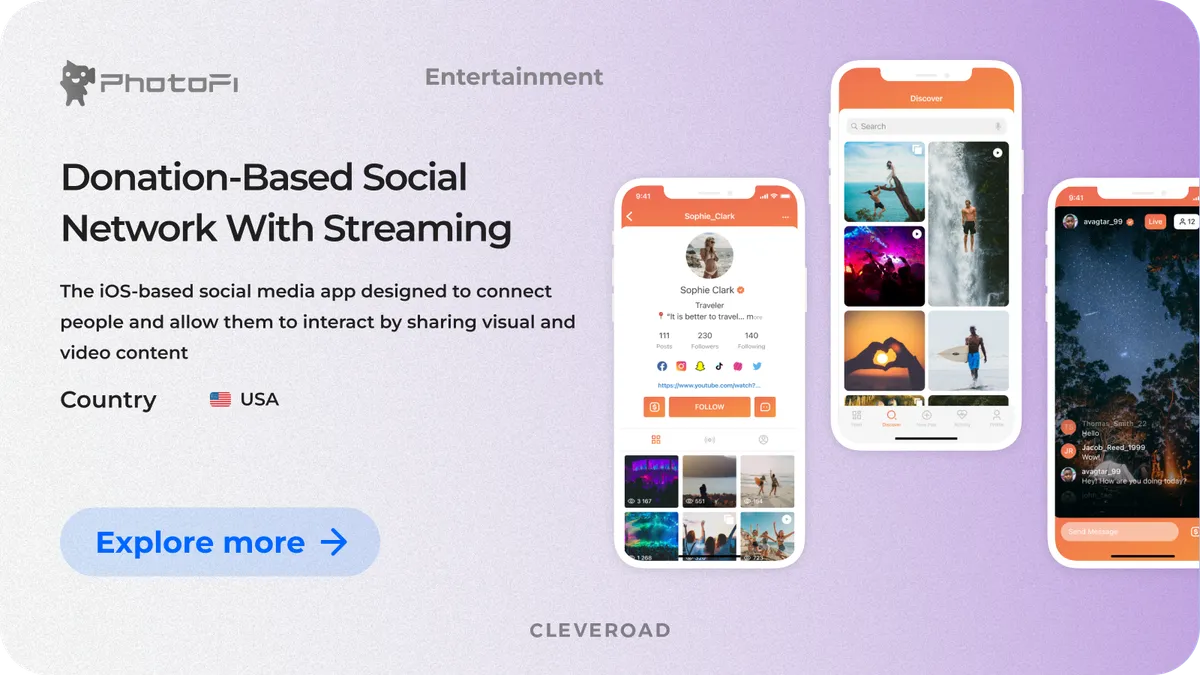
PhotoFi: Donation-based social platform with streaming designed by Cleveroad
Our team delivered a custom iOS application featuring live video broadcasting, donation acceptance, and a subscription module to ensure sustainable business growth. Additionally, we created a web-based admin panel enabling administrators to manage users, monitor app activity, control ad campaigns, and access usage analytics efficiently.
The solution provides a flexible and modular structure, allowing the client to grow their audience while maintaining operational transparency.
As a result, the customer received an app that is now available on the App Store. The platform attracts users through intuitive features such as live streaming, content sharing, and interactive engagement, which enhance user satisfaction and encourage frequent participation. Its monetization options, including subscriptions and donations, create a sustainable revenue model that effectively supports the client’s business objectives.
Build a social media website with domain experts
Our team with 15+ years of experience developing social networking web applications is ready to help you create your own solution aligning with your product vision
A social media website refers to a community where groups of people can interact via chats or online calls, create and share textual or video content, and utilize social features like commenting, liking, and connecting with other users. It also serves as a marketing tool, helping businesses manage content management, plan campaigns, and build a brand. Selecting the right domain name and layout is essential to establishing a professional and user-friendly platform.
Here’s a step-by-step guide to build a social media website:
- Step 1. Define your concept. A clear target audience and USP guide the platform’s unique value.
- Step 2. Choose a development partner. The right team ensures efficiency and scalability.
- Step 3. Run a solution workshop. Align business needs with practical technical solutions early.
- Step 4. Complete the discovery phase. Detailed planning streamlines development.
- Step 5. Prioritize UI/UX design. Intuitive interfaces increase engagement and retention.
- Step 6. Develop social networking website. Developers implement features step by step while QA testing ensures stable, reliable, and functional performance.
- Step 7. Launch and promote. Deploy the platform live and use SEO, social media campaigns, and content strategies to attract users and grow your community.
Creating a social media website from scratch involves planning the concept, designing the interface, developing the backend and frontend, testing functionality, and deploying the platform. Proper attention to layout, responsive design, security, and compliance ensures scalability and a smooth user experience.
Given the development work involved, a social networking website may cost approximately $100,000–$120,000+. This estimate covers building a website and backend development only. Additional expenses for UI/UX, QA, project management, hosting, and ongoing maintenance should be calculated separately.
Social media revenue can be generated through:
- Advertisements. Ads within the platform should integrate smoothly with your design elements and layout to capture user attention.
- Brand promotion. Paid content from companies can be highlighted in feeds, leveraging your content management system for targeting and placement.
- Paid features. Premium subscriptions or additional services provide extra value, such as exclusive access to social features or enhanced personalization.

Evgeniy Altynpara is a CTO and member of the Forbes Councils’ community of tech professionals. He is an expert in software development and technological entrepreneurship and has 10+years of experience in digital transformation consulting in Healthcare, FinTech, Supply Chain and Logistics
Give us your impressions about this article
Give us your impressions about this article