Top 9 Education App Development Companies in Canada for 2026
12 May 2026
15 Min
138 Views
Selecting an education app development company in Canada is not just a matter of comparing portfolios. Canadian education buyers often have very different needs: a school district may prioritize parent access, student privacy, and accessibility, while an EdTech startup may prioritize fast MVP delivery, mobile engagement, analytics, and investor-ready scalability. On top of that, privacy and accessibility requirements differ across provinces, so a vendor that understands general EdTech delivery may still fall short when the product must align with expectations in Ontario, Quebec, or other Canadian markets.
Cleveroad has 15+ years of experience building custom web and mobile software for education, healthcare, fintech, logistics, retail, and other domains where security, integrations, and long-term maintainability matter. For education projects, our team supports the full product path: discovery, learner and admin UX, mobile and web development, LMS or third-party integrations, QA, deployment, and post-launch support. We help clients create learning products that are not only functional at release but also easier to scale, maintain, and adapt to future user needs.
This guide is built to save buyers from sorting through dozens of generic vendor profiles. We reviewed major B2B platforms, including Clutch, DesignRush, GoodFirms, and TechBehemoths, and checked company websites to identify firms with credible Canadian presence, education-related delivery experience, mobile and web development capabilities, and visible awareness of requirements such as PIPEDA, AODA, and Quebec Law 25.
In this guide, you’ll find:
- A curated shortlist of 9 education app development companies with Canadian presence
- The methodology used to evaluate and narrow the vendor pool
- A side-by-side comparison of company offices, services, and industry expertise
- A Canada-specific checkpoint covering compliance, privacy, and accessibility
- Pricing bands and timeline expectations for education app projects
Top 9 Education App Development Companies in Canada
Canadian education buyers often work within several privacy and accessibility frameworks at once. Federal PIPEDA can apply to private-sector EdTech products across Canada, while provincial rules such as Ontario’s MFIPPA and FIPPA, BC PIPA, and Alberta PIPA become relevant when school boards or post-secondary institutions are involved. Quebec Law 25 adds some of the strictest privacy expectations in the region, and Ontario’s AODA requirements raise the bar for accessibility. For Quebec-focused products, French-language localization also needs to be planned during discovery, not added as a late-stage extra. As a result, the vendor market may look broad at first glance, but the number of teams able to deliver within these constraints is much smaller.
Here are the top 9 education app development companies in Canada:
- Mindsea
- Cleveroad
- Konrad
- Pieoneers
- TTT Studios
- Steamclock Software
- 14 Oranges
- Robots and Pencils
- TribalScale
Our team reviewed around 70 candidate companies across major B2B directories and then validated each firm against its public materials, including case studies, awards, named clients, accessibility statements, and service pages. This process narrowed the list to 10 companies with a verifiable Canadian presence, visible EdTech experience, and the ability to deliver both mobile and web products.
Directories and sources reviewed:
- Clutch, for verified client reviews
- DesignRush, for curated agency rankings
- GoodFirms, for peer-reviewed vendor listings
- TechBehemoths, for geo-filtered agency research
- The Manifest, for B2B agency profiles
- Official company websites, About pages, and case study libraries
Selection went beyond simply checking whether a company mentions EdTech on its website. We prioritized firms with named Canadian education work, proven mobile and web delivery, and clear awareness of accessibility and privacy requirements.
Selection criteria applied:
- Canadian head office or full-team Canadian presence
- Public EdTech case studies or named education clients across K-12, post-secondary, EdTech startups, or corporate L&D
- iOS and Android mobile app delivery, plus web platform capability
- Verifiable third-party reviews on Clutch, GoodFirms, or DesignRush
- Awareness of Canadian privacy and accessibility regulations
- Ability to support the product beyond initial release and provide ongoing maintenance
- Recognizable client roster, notable awards, or relevant certifications
Comparison of education app development companies in Canada:
| Company | Offices | Services | Industry Expertise |
Mindsea | Halifax, Canada | iOS, Android, UX/UI design, Product strategy | EdTech, Health & wellness, Productivity |
Cleveroad | Vancouver, Canada; Claymont, Delaware (US) | Mobile development, Web development, UI/UX design, Cloud & DevOps | Education, Healthcare, FinTech, Logistics |
Konrad | Toronto, Canada; New York; Los Angeles | Mobile development, Web platforms, Digital strategy | EdTech, Financial services, Media, Retail |
Pieoneers | Vancouver, Canada | iOS, Android, Web development, Cloud | EdTech, FinTech, Healthcare |
TTT Studios | Vancouver, Canada | Mobile development, Web development, AR/VR | EdTech, Hospitality, Media |
Steamclock Software | Vancouver, Canada | iOS, Android, Product strategy | EdTech, Productivity, Music tech |
14 Oranges | Burnaby, Canada | Mobile development, Custom software, IoT | EdTech, Government, SMB mobile |
Robots and Pencils | Calgary, Canada; Toronto, Canada; Atlanta (US) | Mobile, Web, Salesforce, Data engineering | EdTech, Enterprise, Salesforce ecosystem |
TribalScale | Toronto, Canada; New York; Los Angeles | Mobile, Web, Voice & connected devices | EdTech, Media, Automotive, FinTech |
Which Education App Development Companies Lead the Market in Canada?
Below, our team walks through each shortlisted firm in detail. Cleveroad opens the section with a deep description, and every competitor follows with a substantive paragraph covering capability, buyer fit, and one differentiator the firm is known for.
Mindsea
- Founded: 2006
- Offices: Halifax, Canada
- Hourly Rate: $100–$149/hr
- Industry Expertise: EdTech, Health & wellness, Productivity
- Reviews: 25+ reviews on Clutch, average rating 5.0/5
- Services: iOS, Android, UX/UI design, Product strategy

Mindsea Canada education app development team
Mindsea is a Halifax-headquartered mobile-first studio with shipped products across learning, health, and productivity apps on iOS and Android. The team operates as a small senior unit, with product strategy and UX/UI design tightly integrated with engineering work rather than handed off in phases. Their EdTech portfolio includes apps for K-12 schools and adult learners, with a focus on accessibility, content authoring, and student progress tracking. Atlantic Canada coverage gives Eastern-time clients an early start to the standup day.
Best for EdTech founders who want a compact senior team running discovery, design, and build on one cadence rather than across handoffs.
Cleveroad
- Founded: 2011
- Offices: Vancouver, Canada; Claymont, Delaware (United States)
- Hourly Rate: $50–$99/hr
- Industry Expertise: Education, Healthcare, FinTech, Logistics, Retail
- Reviews: 110+ reviews on Clutch, average rating 4.9/5
- Services: Mobile app development, Web development, UI/UX design, Cloud & DevOps
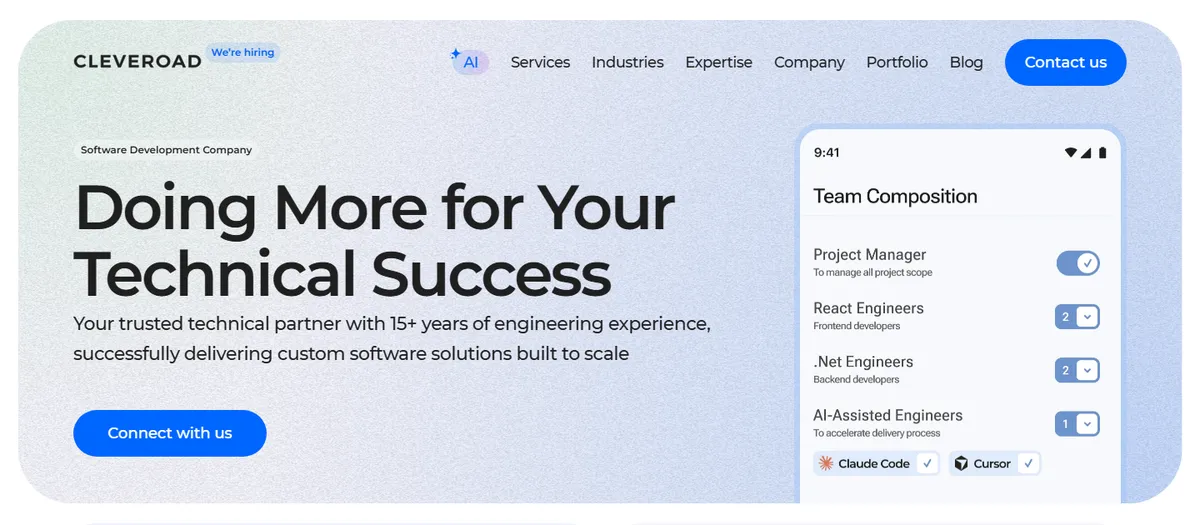
Cleveroad Canada education app development team
We’ve spent 15+ years building education products for K-12, post-secondary, EdTech startups, and corporate L&D buyers, with engineers who know the LMS integrations that Canadian institutions actually deploy: Moodle, Canvas, Brightspace, and Blackboard. Cleveroad ships native iOS apps in Swift, native Android apps in Kotlin, cross-platform builds in React Native and Flutter, and server-side with Node.js, .NET, or Python. Our architecture work covers SCORM and xAPI for content interchange, real-time video for live classes, role-based access for student, parent, teacher, and admin views, payment processing for tutoring marketplaces, and offline-first patterns for low-connectivity classrooms.
Cleveroad holds ISO 9001:2015 and ISO/IEC 27001:2013 certifications for quality management and information security management, and our delivery process accounts for GDPR, HIPAA, and PIPEDA-equivalent privacy frameworks. The firm carries Clutch Champion 2023 and Clutch Global Leader 2025 recognition. Across 200+ delivered projects, education ranks among our largest verticals, with clients consistently reporting reliability, transparent communication, and depth of senior engineering.
Want a closer look at how we build education apps end-to-end? See Cleveroad’s education software development services for the full picture.
Best for Canadian EdTech founders, school boards, and post-secondary institutions that want senior delivery on a budget closer to nearshore than to on-shore rates.
Cleveroad ships education and learning platforms for school districts, post-secondary institutions, and EdTech founders across the United States, Canada, the United Kingdom, and the European Union. For Canadian buyers, our delivery complies with PIPEDA, Quebec Law 25, and AODA accessibility requirements from discovery onwards. In the video, Sean Newman Maroni from Betabox describes the end-to-end engagement Cleveroad ran on his STEM education company’s MVP, a web-based platform that automates internal operations and helps K-12 educators explore curriculum resources.
Sean Newman Maroni’s Betabox testimonial about Cleveroad
Konrad
- Founded: 2008
- Offices: Toronto, Canada; New York; Los Angeles
- Hourly Rate: $150–$199/hr
- Industry Expertise: EdTech, Financial services, Media, Retail
- Reviews: 30+ reviews on Clutch, average rating 4.9/5
- Services: Mobile development, Web platforms, Digital strategy
Konrad Canada education app development team
Konrad is a Toronto-headquartered digital agency that pairs mobile and web engineering with strategy consulting for enterprise and post-secondary buyers. The portfolio carries work for financial services firms, EdTech platforms, retailers, and media brands, with brand and product strategy bundled into the engagement model. Engineering capability spans native iOS and Android, web platform development, and digital strategy, with cross-border offices to support clients running multi-region rollouts.
Best for post-secondary institutions and large EdTech platforms that need brand, product, and engineering under one roof, with consulting depth aligned with executive-level priorities.
Pieoneers
- Founded: 2010
- Offices: Vancouver, Canada
- Hourly Rate: $100–$149/hr
- Industry Expertise: EdTech, FinTech, Healthcare
- Reviews: 25+ reviews on Clutch, average rating 5.0/5
- Services: iOS, Android, Web development, Cloud
Pieoneers Canada education app development team
Pieoneers is a Vancouver-based development studio with multiple shipped EdTech products across K-12 and adult learning. The engineering work covers iOS, Android, web platforms, and cloud-native back ends on AWS, with attention to data security and student privacy from the architecture layer onward. Their EdTech case studies include personalized learning apps, K-12 educator tools, and student-facing platforms that handle content delivery and progress tracking.
Best for BC- and Alberta-based EdTech founders who want a Pacific Time team and depth in cloud architecture, alongside mobile delivery.
TTT Studios
- Founded: 2010
- Offices: Vancouver, Canada
- Hourly Rate: $150–$199/hr
- Industry Expertise: EdTech, Hospitality, Media, AR/VR
- Reviews: 20+ reviews on Clutch, average rating 5.0/5
- Services: Mobile development, Web development, AR/VR
TTT Studios Canada education app development team
TTT Studios is a Vancouver-based agency with notable AR and VR work, alongside core mobile and web delivery, for hospitality, media, and EdTech buyers. The team has shipped spatial learning experiences, simulation-based training, and gamified onboarding products for clients seeking to move beyond a standard 2D learning interface. Engineering capability covers iOS, Android, web, and Unity or Unreal for immersive builds, with design depth that matches the technical breadth.
Best for EdTech founders building next-generation interaction patterns such as VR field trips, AR-augmented textbooks, or simulation-based assessments that mainstream mobile shops do not handle.
Steamclock Software
- Founded: 2010
- Offices: Vancouver, Canada
- Hourly Rate: $150–$199/hr
- Industry Expertise: EdTech, Productivity, Music tech
- Reviews: 20+ reviews on Clutch, average rating 5.0/5
- Services: iOS, Android, Product strategy

Steamclock Software Canada education app development team
Steamclock Software is a Vancouver studio built around small senior teams and high-craft native mobile work on iOS and Android. The firm picks engagements deliberately and runs each as a tight collaborative pod rather than scaling out to a large outsourced delivery team. EdTech projects in the portfolio carry the same emphasis on polish, iteration speed, and direct client-engineer communication that defines the firm’s productivity and music tech work.
Best for EdTech founders who care about app store craft, native platform feel, and a quiet senior engineering bench rather than a 30-engineer pod.
14 Oranges
- Founded: 2009
- Offices: Burnaby, Canada
- Hourly Rate: $100–$149/hr
- Industry Expertise: EdTech, Government, SMB mobile
- Reviews: 10+ reviews on Clutch, average rating 4.9/5
- Services: Mobile development, Custom software, IoT
14 Oranges Canada education app development team
14 Oranges is a Burnaby-based BC firm with a track record in government and education contracts where procurement requirements run tighter than a standard commercial engagement. The team handles mobile development, custom software builds, and IoT work for school boards, provincial bodies, and SMB mobile buyers. Project documentation typically includes Canadian data residency commitments, vendor accountability artifacts, and accessibility conformance reports, the same paperwork public-sector EdTech procurement asks for.
Best for school boards and provincially funded EdTech programs that have fielded a public-sector RFP and need the engagement model already shaped to fit.
Robots and Pencils
- Founded: 2009
- Offices: Calgary, Canada; Toronto, Canada; Atlanta (United States)
- Hourly Rate: $150–$199/hr
- Industry Expertise: EdTech, Enterprise, Salesforce ecosystem
- Reviews: 30+ reviews on Clutch, average rating 4.9/5
- Services: Mobile, Web, Salesforce, Data engineering
Robots and Pencils Canada education app development team
Robots and Pencils is a multi-office firm with a deep Salesforce ecosystem practice and named EdTech, enterprise, and corporate L&D clients. Engineering capability spans mobile, web, Salesforce platform, and data engineering, with experience integrating Salesforce Education Cloud into post-secondary and K-12 deployments. The portfolio includes student information system integrations, donor and alumni management for higher education, and corporate learning platforms tied into Salesforce data layers.
Best for institutions standardizing on Salesforce Education Cloud or enterprise EdTech platforms that need data engineering capability alongside mobile delivery.
TribalScale
- Founded: 2014
- Offices: Toronto, Canada; New York; Los Angeles
- Hourly Rate: $150–$199/hr
- Industry Expertise: EdTech, Media, Automotive, FinTech
- Reviews: 30+ reviews on Clutch, average rating 4.9/5
- Services: Mobile, Web, Voice & connected devices
TribalScale Canada education app development team
TribalScale is a Toronto-headquartered firm that pairs agile delivery training with hands-on engineering across mobile, web, and connected devices for media, automotive, FinTech, and EdTech buyers. The team often runs paired programming and co-engineering engagements that upskill an internal team alongside the build, which works well for EdTech platforms scaling their own product organizations. Engineering capability covers native iOS and Android, web platforms, and voice or connected-device work for clients moving beyond a single screen.
Best for EdTech platforms that want to ship a product and grow their internal capabilities through the same engagement, rather than buying execution alone.
Compliance and Privacy Checkpoints Every Canadian Education App Must Clear
A Canadian education app touches more regulatory surface area than most product teams expect when they begin scoping a build. Federal privacy law sits atop provincial statutes that vary in strictness. Quebec runs its own privacy and language frameworks. Ontario carries an accessibility law with documented enforcement. Public-sector buyers add procurement-level requirements that go beyond commercial product expectations. The engineering decisions that shape compliance, including data residency, consent flows, audit logging, role-based access, and accessibility conformance, sit in the architecture phase, not at the end of the build.
Use the checklist below in vendor conversations. The firms shortlisted earlier in this article work within these constraints daily; a generic offshore mobile shop without Canadian education exposure usually does not.
Compliance and accessibility checklist for Canadian education apps:
- PIPEDA conformance for any private-sector EdTech app collecting student or parent data, with documented consent, purpose limitation, and breach reporting on a federal timeline.
- Quebec Law 25 readiness, including privacy impact assessments, cross-border transfer disclosures, automated decision-making transparency, data portability rights, and the fines that ride on each.
- Provincial privacy statutes for public-sector buyers, including BC PIPA, Alberta PIPA, Ontario MFIPPA and FIPPA, and equivalents, with Canadian data residency typically a procurement clause rather than a vendor preference.
- AODA conformance in Ontario plus federal ACA requirements, with WCAG 2.1 AA as the working baseline for K-12 and post-secondary apps, and documented accessibility statements and audit trails for public-sector vendors.
- Bilingual delivery for Quebec and federal buyers, with French-language UI, voiceover, and content moderation scoped from discovery, and the QA budget adjusted to match.
- Student data protection patterns, including role-based access for student, parent, teacher, and admin views, minor consent flows, data retention rules tied to academic calendars, and audit logging on every privileged action.
- Procurement deliverables for public-sector RFPs, including Canadian-hosted infrastructure, vendor liability insurance, named Privacy Impact Assessment artifacts, accessibility conformance reports, and a documented vulnerability disclosure process.
The 10 firms in the shortlist routinely ship education apps within this set of constraints, which is the practical separator between a Canadian-aligned vendor and a generic offshore mobile shop. If your scope already includes K-12 or post-secondary buyers in Quebec or Ontario, treat the compliance and accessibility surface as part of the architecture brief, not a release-week checklist.
For deeper context on the engineering side, see EdTech software development services for the patterns Canadian education buyers ask vendors to demonstrate.
Closing Insights
The shortlist above was built against the constraints Canadian education buyers actually face, including provincial privacy regimes, federal privacy law, accessibility legislation, public-sector procurement realities, and bilingual delivery expectations. Each firm earned its place through a combination of named EdTech work, mobile and web delivery capabilities, and visible engagement with the privacy and accessibility expectations that accompany any K-12, post-secondary, or corporate L&D build.
Vendor fit beats a directory ranking every time. The right partner for your build is the one whose track record matches the learner segment you serve, the privacy regime in which your data sits, and the accessibility bar your buyers and end users hold you to. Use the comparison table to filter on offices and services, the per-company sections to evaluate fit on engagement style, and the compliance checklist to test how each firm answers procurement questions before you sign anything. Our team is happy to walk through your scope and show how we’d shape a Canadian education built around it.
Build your education app with Cleveroad
Tell us your scope. Our team designs the architecture, integrates with your LMS, and ships a Canadian-aligned learning app end-to-end.
Education app costs in Canada typically run $80,000 to $300,000, depending on scope, regulatory load, and the LMS or backend integrations the build needs. A discovery phase covering scope, architecture, and a privacy impact assessment usually costs $10,000 to $25,000. An MVP for a K-12 or post-secondary app runs $80,000 to $150,000 and ships in three to five months. A full release with bilingual delivery, AODA conformance, and production cloud infrastructure pushes total spend into the $200,000 to $300,000 band. Hourly rates from Canadian onshore firms typically fall in the $100 to $199 range, while firms with offshore-aligned delivery sit in the $50 to $99 range.
- PIPEDA is the federal privacy law for private-sector EdTech apps across Canada and covers consent, purpose limitation, and breach reporting for any app collecting student or parent data.
- Quebec Law 25 is the strictest provincial regime and adds privacy impact assessments, cross-border transfer disclosures, automated decision-making transparency, data portability rights, and fines up to 4% of worldwide revenue.
- Provincial acts such as BC PIPA, Alberta PIPA, and Ontario MFIPPA or FIPPA apply when a public-sector body like a school board, university, or ministry is the buyer, and they typically force Canadian data residency into the contract.
Yes. Canadian data residency is a standard requirement in most public-sector education procurements, and vendors meet it by hosting on regional cloud zones such as AWS Canada Central, Microsoft Azure Canada Central, or Google Cloud’s Montréal region.
- Discovery runs 2 to 4 weeks and covers scope definition, architecture, privacy impact assessment, and accessibility planning.
- MVP design and build runs 4 to 6 months for a K-12 or post-secondary mobile and backend MVP with core functionality.
- Pilot runs 2 to 3 months with a school, cohort, or test district to validate UX, content delivery, and edge-case handling.
- Full release with bilingual delivery, AODA audit, production cloud infrastructure, and rollout support typically extends the timeline another 2 to 3 months.
WCAG 2.1 AA is the working baseline for any K-12 or post-secondary education app shipped in Canada. Ontario’s AODA enforces accessibility for any organization operating in the province, and the regulatory trajectory through 2025 and 2026 tightens the documentation expected from vendors. The federal Accessible Canada Act applies to federally regulated buyers and to any app touching federal procurement. Practical implications run through the design and QA budget, including keyboard navigation, screen reader compatibility, color contrast, captioning, and accessibility statements as deliverables. Public-sector buyers increasingly hold vendors to documented audit trails rather than self-attestation.

Evgeniy Altynpara is a CTO and member of the Forbes Councils’ community of tech professionals. He is an expert in software development and technological entrepreneurship and has 10+years of experience in digital transformation consulting in Healthcare, FinTech, Supply Chain and Logistics
Give us your impressions about this article
Give us your impressions about this article